橙字logo(1).png
Literature Sharing | Evening Blue Light Exposure and Sleep Performance
【Introduction】
With the rapid expansion of digital device usage and artificial indoor lighting, evening exposure to blue light has become increasingly common, particularly among adolescents and young adults. Numerous studies have demonstrated that blue light exposure at night can disrupt circadian rhythm regulation and suppress melatonin secretion. However, the specific impact of different timing windows of blue light exposure on sleep quality, motor performance, and cognitive function remains insufficiently clarified.
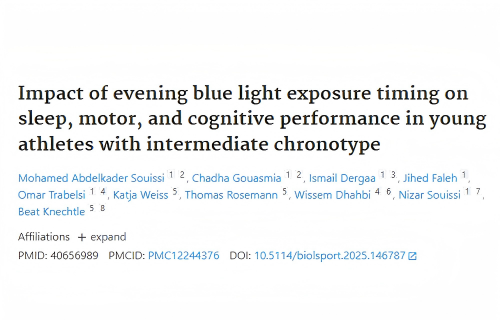
Source:Biology of Sport. 2025. PMID: 40656989 DOI: 10.5114/biolsport.2025.146787
【Study Design and Experimental Conditions】
The study recruited 16 male adolescent athletes (mean age: 15.11 ± 0.92 years) and applied a randomized crossover design including four experimental conditions:Blue light exposure (BLE) from 7:30–9:00 PM;BLE from 9:00–10:30 PM;BLE from 10:30 PM–12:00 AMControl (no blue light exposure).Sleep quality and duration were assessed using validated sleep questionnaires (Spiegel and Vis-Morgen). Selective attention was evaluated using the Bells Test, while motor performance was measured by dart-throwing accuracy and movement duration.This crossover methodology allowed each participant to serve as his own control, improving statistical reliability despite the relatively small sample size.
【Impact of Blue Light Timing on Sleep Quality】
The analysis revealed significant main effects of exposure timing on total sleep duration.Compared to the control condition:Blue light exposure from 9:00–10:30 PM significantly reduced total sleep duration (medium effect size, d = 0.54).Exposure from 10:30 PM–12:00 AM resulted in even greater sleep reduction (large effect size, d=0.87).Additionally, exposure after 9:00 PM resulted in shorter sleep compared to the earlier 7:30–9:00 PM condition.These findings suggest that 9:00 PM represents a critical threshold, beyond which blue light exposure substantially disrupts sleep duration.
【Effects on Motor Performance】
Motor performance was significantly impaired when blue light exposure occurred after 9:00 PM.Dart-Throwing Accuracy Significantly lower in both late exposure conditions.Large effect size observed in the 10:30 PM–12:00 AM condition (d = 1.41).Movement Duration Significantly prolonged in the late exposure groups.Large effect sizes (d > 1.5), indicating substantial neuromotor impairment.These results indicate that evening blue light exposure not only influences sleep but also negatively affects next-day motor coordination and precision.
【Effects on Cognitive Function】
Selective attention scores were significantly reduced in both post-9:00 PM exposure conditions:9:00–10:30 PM: medium effect size (d = 0.66).10:30 PM–12:00 AM: large effect size (d = 0.91).This suggests that late-evening blue light exposure impairs neurobehavioral performance, likely due to circadian misalignment and insufficient sleep recovery.
【Practical Implications for Evening Lighting】
The findings emphasize the importance of minimizing blue-light exposure after 9:00 PM.From a lighting design and product application perspective, this suggests:Reducing cool white lighting (>4000K) in evening environments.Avoiding digital screen exposure close to bedtime.Transitioning to low-intensity warm lighting (<3000K) in bedrooms.Supporting circadian-friendly indoor illumination strategies.Warm-tone lighting significantly reduces blue wavelength emission, thereby helping preserve natural melatonin secretion.