Guangzhou Bowei Trading Co., Ltd.

Literature Sharing | Preschool Children's Extreme Sensitivity to Evening Light and Melatonin Suppression
【Introduction】
Children's sleep is foundational to their growth, learning, emotional regulation, and long-term health, yet behavioral sleep problems remain common across early childhood. While many factors contribute to childhood sleep difficulties, an often underestimated factor is the lighting environment in which children spend their evening hours. Adults are known to experience melatonin suppression from nighttime light in a dose-dependent manner, meaning brighter light typically produces stronger suppression. However, much less has been understood about how young children, whose visual and circadian systems are still developing, respond to evening light exposure. To address this gap, a notable study published in the Journal of Pineal Research examined how preschool-aged children's melatonin levels respond to a wide range of evening light intensities, providing critical insight into how household lighting environments may shape childhood sleep biology.
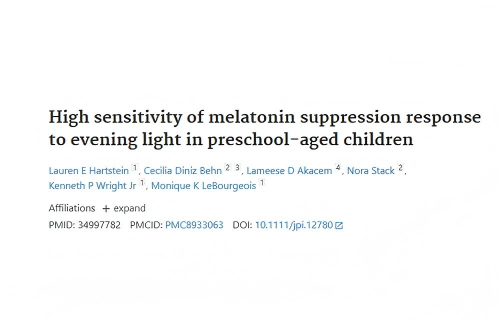
Journal of Pineal Research | 2022 | PMID: 34997782 | DOI: 10.1111/jpi.12780
【Study Design and Experimental Conditions】
The study recruited 36 healthy, good-sleeping children aged 3.0 to 4.9 years, with 39 percent male participants, all of whom maintained a stable sleep schedule for seven consecutive days prior to laboratory assessment. Following this stabilization period, each child completed a 29.5-hour in-home dim-light circadian assessment under approximately 1.5 lux of background illumination, ensuring a controlled baseline melatonin profile. On the final night of the protocol, children were exposed to one hour of light at varying intensities ranging from 5 to 5000 lux, randomly assigned across 15 different light levels with at least two participants per level, during the hour preceding their habitual bedtime. Salivary melatonin samples were collected to measure the magnitude of melatonin suppression during light exposure compared to baseline levels from the previous evening, as well as the degree of melatonin recovery 50 minutes after the end of light exposure, providing a comprehensive view of how preschool children's circadian systems respond to and recover from evening light.
【Profound Melatonin Suppression Across All Light Intensities】
The results revealed a striking finding that distinguishes young children from adults in their response to evening light. Across the full range of tested light intensities, melatonin levels in preschool children were suppressed between 69.4 percent and 98.7 percent, with an average suppression of 85.4 percent during the one-hour exposure period. Unlike adults, who typically show a clear dose-dependent relationship between light intensity and melatonin suppression, preschool children did not exhibit an overall intensity-dependent response, indicating that even relatively low levels of evening light can produce profound circadian effects in this age group. This suggests that the developing circadian system of young children may be substantially more sensitive to light than that of adults, with even modest evening illumination capable of nearly fully suppressing melatonin production.
【Even Very Low Light Levels Cause Significant Suppression】
A particularly important finding emerged from the comparison of light intensity quartiles. Children exposed to the lowest quartile of light intensities, ranging from just 5 to 40 lux, still experienced an average melatonin suppression of 77.5 percent, which was lower than the suppression observed at the higher quartiles (86.4 percent, 89.2 percent, and 87.1 percent respectively) but nonetheless represents a substantial circadian disruption. To put this in perspective, 5 to 40 lux corresponds to extremely soft ambient lighting, far dimmer than typical household room lighting, yet still produced over 75 percent melatonin suppression in young children. This finding underscores that virtually any evening light exposure in the hour before bedtime can meaningfully suppress melatonin in preschool-aged children, making careful lighting management in children's bedrooms and nighttime environments particularly important.
【Prolonged Melatonin Recovery After Light Exposure】
Beyond the immediate suppression effects, the study also examined how quickly melatonin levels recovered after the light exposure ended. The findings revealed that melatonin levels remained below 50 percent of baseline for at least 50 minutes after the end of light exposure in 62 percent of participants, and importantly, this recovery period was not influenced by the original light intensity. This means that once a young child's melatonin has been suppressed by evening light, the circadian system requires substantial time to recover, even after the light source is removed. This prolonged recovery period further amplifies the impact of evening light exposure on children's sleep biology and highlights the importance of minimizing light exposure well in advance of bedtime to allow melatonin levels to rise naturally and support healthy sleep onset.
【Practical Implications for Children's Evening Lighting】
These findings carry profound implications for how households should approach evening lighting in environments where young children are present. Because preschool-aged children show near-maximal melatonin suppression across virtually all light intensities tested, including levels as low as 5 lux, traditional bright overhead lighting, screen-emitting devices, and even moderately bright lamps in children's bedrooms may be silently disrupting their circadian timing and contributing to bedtime resistance, delayed sleep onset, and behavioral sleep problems. From a lighting product perspective, this highlights the critical importance of using ultra-low-intensity, warm-tone night lights in children's rooms during the pre-bedtime hour, ensuring that any necessary illumination remains gentle enough to minimize melatonin suppression while still providing comfort, safety, and reassurance. Bedtime environments for young children should prioritize warm color temperatures, minimal brightness, and soft diffused light that supports rather than disrupts the development of healthy circadian rhythms.
【Conclusion】
This 2022 study published in the Journal of Pineal Research demonstrates that preschool-aged children are extraordinarily sensitive to evening light exposure, experiencing 69 to nearly 99 percent melatonin suppression across light intensities ranging from just 5 to 5000 lux, with prolonged recovery periods lasting at least 50 minutes after the light source is removed. These findings reveal that the developing circadian system in young children responds far more dramatically to evening light than the adult system, making careful lighting choices in children's spaces an essential consideration for healthy sleep development. Our decorative acrylic and crystal night light collection is thoughtfully designed with these scientific insights in mind, featuring soft warm-tone illumination, gentle low-intensity output, and child-friendly aesthetics that provide comforting nighttime ambiance without overwhelming a child's sensitive circadian system. Whether used in nurseries, children's bedrooms, or family hallways, our night lights deliver the perfect balance of safety, comfort, and visual charm, offering parents a science-aligned lighting solution that respects the delicate biology of childhood sleep. Choose lighting that nurtures your child's natural rhythm — choose night lights designed with science in mind.