
Literature Sharing | How Ordinary Room Light Before Bedtime Suppresses Melatonin
【Introduction】
Most people consider their indoor home lighting to be soft, comfortable, and harmless to health. Yet emerging chronobiology research reveals that even ordinary room-level illumination, the kind found in nearly every household during the hours before bedtime, can meaningfully suppress melatonin secretion and disrupt the body's internal night signal. While dim ambient light has long been considered safe for evening use, few people are aware that standard residential lighting may be quietly altering circadian biology and shortening the body's biological night. To investigate this overlooked yet widespread issue, a landmark study published in the Journal of Clinical Endocrinology and Metabolism analyzed how exposure to typical room light in the hours before bedtime affects melatonin onset, duration, and suppression compared to dim light conditions. The findings are striking and carry meaningful implications for evening lighting choices in modern homes.
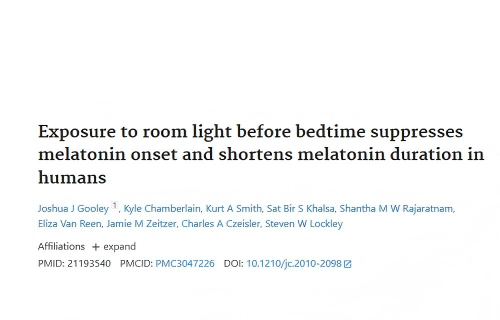
Journal of Clinical Endocrinology and Metabolism | 2011 | PMID: 21193540 | DOI: 10.1210/jc.2010-2098
【Study Design and Experimental Conditions】
The study recruited 116 healthy adult volunteers aged 18 to 30 years, who participated in one of two controlled studies conducted within a General Clinical Research Center for at least five consecutive days. Participants were assigned to live under either room light conditions of less than 200 lux, representing the typical ambient brightness of standard household lighting, or dim light conditions of less than 3 lux, representing a near-darkness environment. The lighting exposure occurred during the eight hours preceding habitual bedtime, allowing researchers to isolate the impact of evening light intensity on melatonin biology. Melatonin signaling was evaluated through several key indicators, including melatonin onset, melatonin offset, total melatonin duration, suppression magnitude, and the phase angle of entrainment, providing a comprehensive picture of how room-level lighting influences the body's internal night representation.
【Impact of Room Light on Melatonin Onset】
The results revealed a profound effect of standard room lighting on melatonin biology. Compared with dim light conditions, exposure to room light in the hours before bedtime suppressed melatonin and resulted in a delayed melatonin onset in 99 percent of participants, demonstrating an almost universal sensitivity of the human circadian system to ordinary household lighting. This delayed onset means that the body's biological signal for nighttime begins later than it should, which can interfere with natural sleep timing and reduce the restorative window during which melatonin can support physiological recovery. The near-universal nature of this effect suggests that virtually every individual exposed to typical evening home lighting experiences some degree of circadian disruption.
【Impact on Melatonin Duration and Nighttime Suppression】
Beyond delaying melatonin onset, room light exposure also shortened the total duration of melatonin secretion by approximately 90 minutes, effectively compressing the body's internal night by one and a half hours. Furthermore, when room light was present during the usual hours of sleep, melatonin levels were suppressed by more than 50 percent in 85 percent of trials, indicating that even modest light intrusion during sleep can dramatically reduce circadian hormone production. These findings suggest that ambient lighting present both before and during sleep can profoundly alter the body's internal representation of night, with potential downstream consequences for sleep quality, hormonal balance, metabolic function, and cardiovascular health.
【Practical Implications for Evening Lighting】
The findings highlight an important and often overlooked truth about modern home environments: even standard, comfortable-feeling room lighting may be sufficient to disrupt circadian rhythm regulation. From a lighting design perspective, this underscores the value of transitioning away from bright, broad-spectrum room lighting in the hours preceding bedtime, and toward low-intensity, warm-tone illumination that minimizes melatonin suppression while still providing adequate visibility and comfort. Bedroom and living-room environments should ideally maintain dim, warm light during the late evening, with any nighttime illumination designed to fall well below circadian-disrupting thresholds. This approach allows the body's natural melatonin signal to begin on time, persist for its full duration, and support the deep, restorative sleep that human biology depends on.
【Conclusion】
This landmark study demonstrates that ordinary room lighting, of the kind present in nearly every household, exerts a profound suppressive effect on melatonin secretion, delaying its onset in 99 percent of individuals, shortening its total duration by approximately 90 minutes, and reducing nighttime levels by more than 50 percent when present during sleep. These effects shorten the body's internal night and may contribute to long-term disruptions in sleep quality, thermoregulation, blood pressure, and glucose homeostasis. Such evidence makes it clear that evening lighting choices are far more than a matter of comfort or aesthetics — they are a meaningful factor in long-term health. Our decorative acrylic and crystal night light collection is thoughtfully designed in alignment with these scientific principles, offering soft warm-tone illumination, low-intensity output, and circadian-friendly color temperatures that provide gentle, atmospheric light without overwhelming the body's natural melatonin signal. Whether used in bedrooms, nurseries, hallways, or relaxation spaces, our night lights deliver beauty, comfort, and safety while respecting the biological rhythms that govern healthy sleep. Choose lighting that supports your body's natural night — choose night lights designed with science in mind.